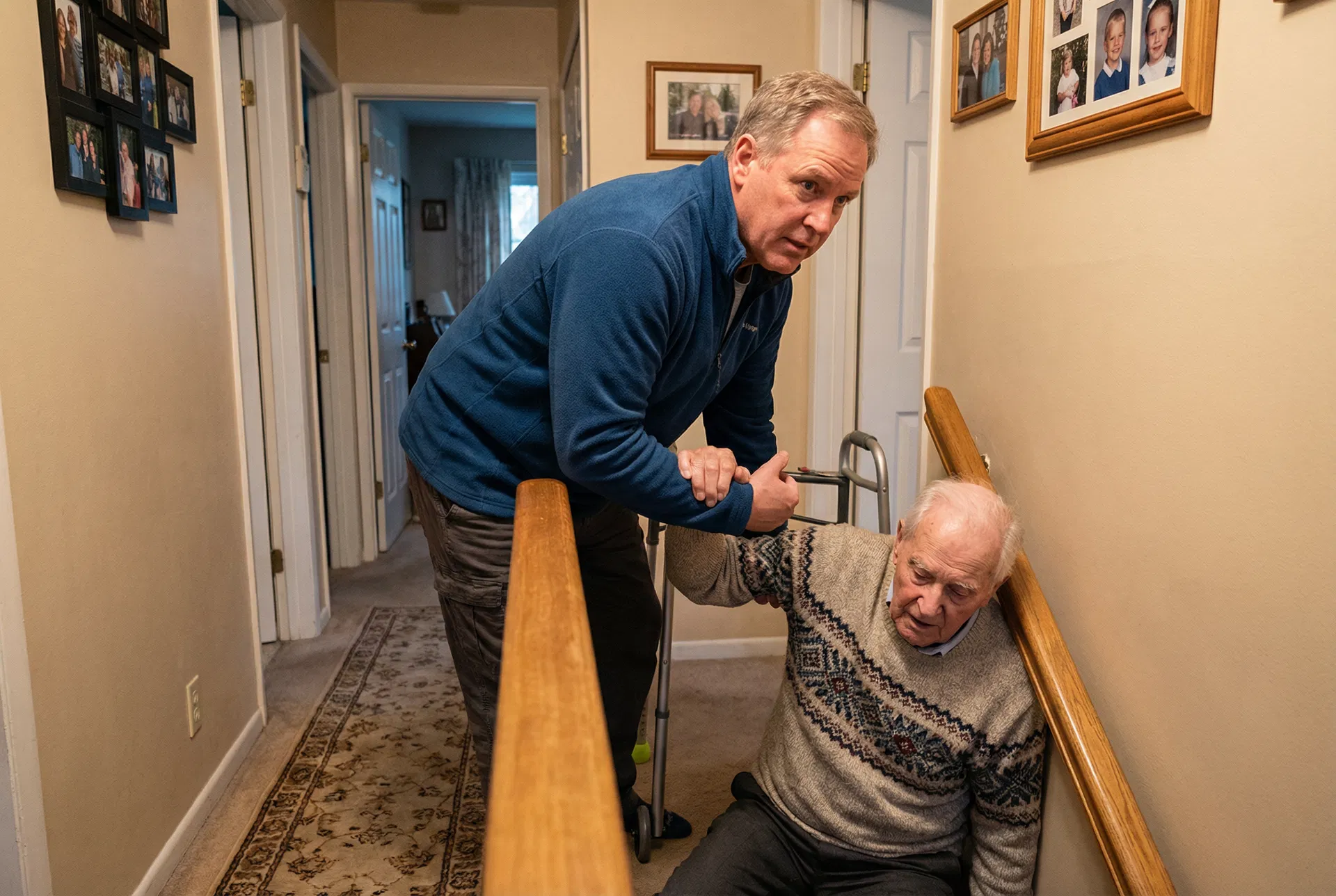

When Adult Day Care Is No Longer Enough: Signs It’s Time for Assisted Living
Learn when adult day care plus care at home may no longer cover an older adult’s supervision, personal-care, or overnight safety needs.

Practical guides, expert insights, and real-world advice to help families navigate senior care with confidence.
For families facing an immediate crisis — a fall, wandering, hospital discharge, or sudden decline.

Learn when adult day care plus care at home may no longer cover an older adult’s supervision, personal-care, or overnight safety needs.


Compare rehabilitation, skilled nursing, home health, home care, and assisted living after an older adult’s ICU stay using current care needs.

A practical first-hours and first-days plan when an aging parent’s primary caregiver dies and dependable care coverage is suddenly unavailable.

A long-distance caregiving guide to compare locations, verify assisted-living communities, organize records, and plan an interstate care transition.

Learn how to evaluate a nursing-home-to-assisted-living move using current care needs, provider assessment, records, and transition planning.

A cautious guide to distinguish a nursing-facility responsible-party role, resident-funds duties, and a personal payment guarantee before signing admission paperwork.

A practical guide for families when an existing nursing-facility resident’s return after hospitalization is uncertain, with questions about policy, records, care needs, and next steps.

A practical transition-planning guide for long-term nursing-facility residents exploring home or community options, available supports, and state-program limits.

A practical remote-coordination plan for permissions, local support, care-setting questions, transportation, and backup plans.

A plain-language guide to the Medicaid-certified nursing-facility screening framework, the questions it does and does not answer, and what to ask during a referral.

A practical screening guide for families comparing assisted living, rehabilitation, skilled nursing, and home-based support after traumatic brain injury.

A practical urgent-placement workflow for documenting care needs, preparing a referral, comparing skilled nursing options, and separating safety, coverage, and availability questions.

A decision guide for an accepted or provisionally accepted move that cannot occur on schedule: clarify conditions, room status, temporary care, charges, and backup options.

Separate the agreement and refund question from the urgent next-provider search after a pre-move admission failure.

Clarify room hold, ongoing charges, reassessment, return conditions, and next settings after a hospital stay.

A cautious contract-stage guide to signature roles, representative capacity, and questions to clarify before admission.

Turn a medication-capability rejection into task-specific questions for the current or next provider.

Screen wheelchair mobility, transfers, toileting, accessibility, emergency planning, staffing, and reassessment before choosing a community.

A cautious admission-stage guide to provider financial-document requests, service pricing, responsible-party terms, and questions to clarify before signing.

Clarify the trigger, staffing limits, outside-support options, costs, and realistic next care-setting choices before a placement crisis develops.

Screen transfers, equipment, physical space, staffing, and emergency planning before choosing a community.

A provider-screening guide for orientation, daily support, accessible routines, and changing safety needs.

A post-rehab care-setting guide for mobility, transfers, bathroom fit, outside services, and reassessment.

Screen function, cognition, clinician coordination, changing needs, and the community’s care-setting fit.

A provider-screening guide for cancer treatment days, changing daily support, appointments, and assisted-living care-plan fit.

Screen mobility, fatigue, transfers, continence, equipment, overnight support, and a changing MS care plan.

A care-setting guide for earlier-stage CKD, function, clinician-directed support, appointments, and future planning before dialysis.

A secure-memory-care provider-screening guide for dementia, diabetes routines, support boundaries, and changing needs.

A provider-screening guide for families weighing COPD-related daily support, respiratory routines, changing needs, and assisted-living fit.

Families can use this guide to screen assisted-living emergency processes, daily support, medication policies, and overnight coverage.

A care-setting guide for meal supervision, clinician-directed plans, task ownership, and swallowing-related provider screening.

Understand how hospice and assisted living can coordinate services, daily support, nights, and a changing care plan.

A progressive care-setting guide for screening current function, equipment, overnight needs, reassessment, and community capability.

When memory care itself may no longer fit, this guide helps families identify the care gap, screen the next setting, and plan a safer transition.

A memory-care refusal can clarify the next placement search. Learn what to ask, what records to prepare, and which capabilities to screen.

Families need to screen for secure dementia support and transfer capability together—not assume that a lift or a memory-care label answers the question.

A dementia-specific setting comparison for families weighing secure supervision, medical complexity, physical dependency, and daily life.

A provider-screening guide for families assessing whether assisted living can support a parent’s heart-failure-related daily plan.

When supervision needs have moved beyond occasional help, families need a practical way to close the gaps between visits. This guide explains what continuous supervision means, what options exist, and how to decide what is safe.

A task-by-task guide to transfer staffing, equipment, overnight coverage, and the questions families should ask before choosing a community.

Repeated falls from bed are not simply a nighttime inconvenience. This guide covers immediate safety steps, the causes to discuss with a clinician, and when the care plan needs more support.

Bathroom dependence changes the entire care plan. Learn how to assess toileting support, transfer needs, overnight coverage, and when the current arrangement may no longer be adequate.

When paid home-care coverage suddenly disappears, this guide helps families close the immediate safety gap and decide whether the current care plan is still sustainable.

Waiting feels safer — but delay is one of the most common and costly mistakes families make. This guide explains the real consequences of waiting too long and what to do before a crisis forces the decision.

The answer ranges from 24 hours to 60 days — and the difference depends almost entirely on how prepared you are. This guide breaks down the real timeline, what causes delays, and how to move faster when time is limited.

Moving into assisted living in LA can happen in 24 hours — or take 30–60 days. Understanding timelines, delays, and how to prepare is the difference between a smooth transition and a stressful crisis.

Being discharged from assisted living is stressful — but more common than families expect. The key is understanding why it happens and what to do immediately to protect your loved one.

If your parent is leaving the stove on or wandering out of the house, this is urgent. These behaviors signal cognitive decline and require a clear 72-hour action plan — especially in Los Angeles.

A practical, day-by-day playbook for finding assisted living in Los Angeles under pressure — after a hospital discharge, fall, or sudden decline.

A second fall is not just another incident — it's a major warning sign. For families in Los Angeles, this is often the moment when decisions can no longer be delayed.

The first 72 hours after hospital discharge are critical. This step-by-step LA guide covers what to do before leaving the hospital, the first 24 hours at home, and how to prevent readmission.

A fall can be the turning point where independent living stops being safe. Here's a step-by-step guide for LA families who need to act fast.

When a crisis hits — a fall, a hospital discharge, a sudden decline — families need to act within days. This guide covers urgent placement options in Los Angeles and how to move fast without making costly mistakes.

Caregiver burnout builds gradually until it becomes unsafe — for both the caregiver and the person receiving care. This guide covers the specific signs of burnout and the concrete steps to take immediately, before a crisis forces the decision.

There is no easy way to have this conversation — but families who have it proactively consistently report better outcomes. This guide covers what to say, what not to say, how to handle resistance, and how to move from conversation to action.

Caregiver burnout rarely announces itself. It builds through small concessions, missed appointments, and the gradual erosion of your own health. This guide covers how burnout quietly develops, the warning signs most caregivers miss, and what to do before it becomes a crisis.

The guilt that follows placing a parent in memory care is one of the most universal and least-discussed experiences in family caregiving. This guide covers why it happens, what research says about care outcomes, and how families find peace with the decision.

Managing care for a parent from a distance is one of the most stressful situations a family can face. This guide covers how to coordinate care remotely, when to visit, how to build a local support team, and when distance caregiving is no longer enough.

If you can't take care of your parent anymore, you are not failing — you are recognizing a structural reality. This guide covers your real options: home care, assisted living, memory care, and skilled nursing — with specific criteria for choosing the right level.
The articles families return to most — and share with siblings who are still deciding.

Most families never seriously consider board and care homes — not because they evaluated them and said no, but because they didn't know they existed. Once they do, some find the fit is better than anything a larger community could offer.

The advertised monthly rate is not what families actually pay. The gap between the base rate and the real monthly total — after care-level charges, medication management, and incontinence supplies — is one of the most common and costly surprises in senior care.

The families who navigate care decisions most successfully are not the ones who found the perfect option. They are the ones who started earlier than felt necessary — before a fall, before a hospital discharge, before the conversation became urgent.
Understand what care actually costs in Los Angeles and how to plan your finances before making a decision.
One of the most frightening situations a family can face — but options often exist. Covers Medicaid waivers, VA benefits, home equity, 4 real family scenarios, a 5-step emergency action plan, 5 common mistakes, and 20 FAQs.
Medicare does NOT pay for assisted living. This guide explains exactly what Medicare covers, what it doesn't, and what families can use instead — including Medicaid, VA benefits, and LTC insurance. Includes 4 real family scenarios, 4 myth-busters, a 12-step action plan, and 15 FAQs.
Medicaid may help pay for assisted living — but not in the way most families expect. This guide explains HCBS waivers, eligibility, spend-down strategies, Medicaid vs Medicare, 4 real family scenarios, a 15-step action plan, and 15 FAQs.
If you're worried your family can't afford assisted living, there are more options than most people realize. This guide covers Medicaid waivers, VA benefits, reverse mortgages, bridge loans, 4 real family scenarios, a 15-step action plan, and 15 FAQs.
The national average cost of assisted living in 2026 is $4,500/month. But costs range from $3,000/month in Mississippi to $6,950/month in Alaska. Compare all 50 states, understand what's included, and learn exactly how families pay for it.
Surviving spouses of wartime veterans may qualify for up to $1,432/month in VA Aid and Attendance benefits to help pay for assisted living or memory care — even if the veteran passed away years ago. Most families never apply because they don't know this benefit exists.
Millions of veterans and surviving spouses qualify for a VA benefit that pays $1,518–$2,795/month toward assisted living costs — and most families have never heard of it. This guide explains eligibility, 2026 benefit amounts, and the 5-step application process.
The national average monthly cost of assisted living is $4,900 — but costs range from $3,600 in Mississippi to $8,200 in Alaska. This comprehensive guide covers all 50 states, what's included, hidden fees, and how families pay.

A practical guide to legal, financial, and planning strategies that help families preserve assets, fund quality care, and avoid costly mistakes — including Medicaid planning, VA benefits, trusts, and LTC insurance.

The national median cost of memory care is $6,935/month — but what families actually pay varies widely. This guide covers 50-state pricing, hidden fees, payment options including Medicaid and VA benefits, budget examples, and 20 FAQs.

Independent living and assisted living serve very different needs. This guide explains the key differences, compares costs, and gives your family a practical decision checklist to choose the right option.

Family caregiving has financial, physical, emotional, and relational costs that are rarely discussed honestly. Includes a burnout self-assessment checklist, home care vs family caregiving comparison, 4 real caregiver stories, and 20 FAQs.

The most comprehensive guide for families preparing for an elderly parent's hospital discharge. Covers 6 discharge options, Medicare coverage, home safety assessment, 24-item interactive checklist, 4 real family examples, and 15 FAQs. Includes the critical inpatient vs. observation status distinction.

The most practical guide for families facing hospital discharge when an elderly parent lives alone. Covers discharge rights, Medicare appeals, safety assessment, 5 care options, 24-item checklist, 4 real family examples, and 15 FAQs.

The most comprehensive guide for families navigating post-rehab care decisions. Covers 6 discharge paths, Medicare coverage, home safety assessment, 22-item interactive checklist, 4 real family examples, and 15 FAQs.

The most comprehensive guide explaining the difference between skilled nursing facilities and rehabilitation facilities. Covers side-by-side comparison, Medicare coverage, costs, real family examples, and 15 FAQs.

The most practical hospital discharge question guide for families of elderly patients. Covers 25 questions across 7 categories, 10 overlooked questions, discharge red flags, 25-item interactive checklist, 4 real family examples, and 15 FAQs.

The most comprehensive guide explaining who makes rehabilitation discharge decisions and what families should expect. Covers the roles of physicians, therapy teams, Medicare, and families — with a 20-item checklist, 4 real family examples, and 15 FAQs.

The most comprehensive guide helping families decide between home care and rehabilitation after a senior's surgery. Covers side-by-side comparison, Medicare coverage, costs, safety, 4 family examples, 20-item checklist, and 15 FAQs.

The most comprehensive guide for families navigating care decisions when a parent cannot safely return home after rehabilitation. Covers 4 care options, 8 safety signs, Medicare, 4 family examples, 20-item checklist, and 15 FAQs.

The most comprehensive guide explaining how long Medicare pays for rehabilitation. Covers SNF coverage days 1–100, 2026 copay amounts, what ends coverage early, 5 myths debunked, 4 family examples, 18-item checklist, and 20 FAQs.

8 signs an elderly parent may need assisted living after hospitalization: falls, medication difficulty, ADL challenges, cognitive changes, repeated admissions, caregiver burnout, unsafe home, and isolation. Includes comparison table, readiness checklist, 4 family examples, and 20 FAQs.

The hospital is already talking about discharge — and you're not sure your parent is ready. This guide covers what to ask, what to watch for, and how to navigate the care decisions that follow — home care, rehabilitation, assisted living, and memory care.

Conversation scripts, myth-vs-fact table, 20 FAQs, and an interactive family checklist for adult children navigating the assisted living conversation with a resistant or reluctant parent.

Not sure if what you're seeing is normal aging or something more serious? This guide covers 15 warning signs, a side-by-side comparison table, an interactive family observation checklist, and 20 FAQs to help you decide when to seek an evaluation.

Practical strategies for families navigating a parent who refuses home care, assisted living, or any assistance. Includes conversation scripts, a safety checklist, 8-step action plan, and 20 FAQs.

10 realistic funding options — VA benefits, Medicaid waivers, LTC insurance, home sale strategies, bridge loans, and combination plans. Includes four detailed financial scenarios and an interactive planning checklist.

Most families wait 18 months after recognizing the first warning sign before taking action. These 15 signs — from frequent falls to caregiver burnout — help you see the pattern earlier. Includes an interactive readiness checklist.

The first tour is designed to impress. These seven questions cut through the marketing and get to what actually matters — before you sign anything. Includes a comparison worksheet and red flags checklist.

The distinction matters enormously — for safety, for quality of life, and for cost. A complete guide to understanding when assisted living is enough and when memory care becomes necessary.

The national median is $5,419–$6,200 per month — but what your family actually pays depends on location, apartment size, and care needs. All 50 states, hidden fees, and every payment option explained.

Assisted living is rarely paid for by a single source. Most families combine savings, family support, insurance, and limited benefits. This guide explains who actually pays and how to plan realistically in Los Angeles.

Home care sounds affordable until you calculate the real monthly total. This guide breaks down 2026 LA home care costs by hours per day, what drives prices higher, and when assisted living becomes the more cost-effective option.

Prices vary widely and the numbers can be overwhelming. This guide gives you real 2026 cost ranges, what drives pricing, and how to plan so you can make a decision quickly and confidently.

Home care may seem cheaper hourly, but full-time care and hidden costs can make assisted living the more practical option. A clear 2026 cost breakdown for LA families.

Most families don't have enough savings to cover years of assisted living. The key is understanding your options early — before a crisis forces rushed decisions.

When the money runs out or was never there, families face a frightening question. The answer is more hopeful than most expect — but only if you act before a crisis forces the decision.

When assisted living costs $5,500–$8,000 per month in Los Angeles, every dollar of tax relief matters. The answer is: sometimes — and the difference can mean thousands of dollars back in your pocket.

Medicaid and assisted living is one of the most misunderstood topics families face. Assuming Medicaid will fully cover the cost — and discovering the reality too late — is one of the most common and costly mistakes in senior care planning.

Selling the family home feels like erasing a lifetime of memories — but it's not the only option. There are multiple ways to fund care while preserving the property, each with trade-offs families need to understand early.

The advertised monthly rate is rarely what families actually pay. Many only discover the true cost after move-in — when additional fees and rising care needs significantly increase monthly expenses.

The cost of assisted living can feel out of reach — but most families have more options than they realize. This guide explains real funding paths, common myths, and what the risks of waiting look like.

LA's high housing costs and complex benefit rules make financial planning essential. This guide breaks down real 2026 costs, payment options, common mistakes, and a step-by-step plan for when time is limited.

Monthly costs of $4,000–$7,000+ and savings nearly gone. This guide walks through every realistic option — Medicaid, home equity, VA benefits, family contributions — and what actually works when money is limited.

Many veterans and their families don't realize they qualify for monthly VA payments toward assisted living or home care. This guide explains Aid & Attendance, who qualifies, how much it pays, and how to apply.

When a parent can no longer make safe decisions, families face urgent legal choices. This guide explains the key differences between Power of Attorney and guardianship, when each applies, and how to avoid costly mistakes.

The fear that Medicaid will "take everything" is largely based on misinformation. This guide explains how Medicaid actually works, what assets are protected, the 5-year look-back rule, and when to consult an elder law attorney.

Power of attorney is the single most important legal document in elder care planning. Without it, families can find themselves legally unable to manage a parent's finances or make medical decisions — even in an emergency. This step-by-step guide covers everything you need to know.
In-depth guides on VA benefits, Medi-Cal, how families actually fund care, and what to do when money is limited.
VA Aid & Attendance Complete Guide
Monthly payments of $1,200–$2,800 that many veterans never claim. Eligibility, application, and what it covers.
Memory CareHow Families Actually Pay for Memory Care
8 real-world funding sources with 'in practice' notes — what works, what doesn't, and what families combine.
Care TransitionWhen Home Care Stops Being Enough
The transition from in-home care to residential care — warning signs, cost comparison, and how to move forward.
VA BenefitsHow Veterans Actually Pay for Assisted Living
Beyond Aid & Attendance — the full picture of VA benefits, state programs, and how veterans fund care in California.
Financial OptionsWhat to Do When You Think You Can't Afford Memory Care
Medi-Cal, board-and-care homes, and the options families overlook when the numbers seem impossible.
All GuidesBrowse All Paying for Care Guides →
The complete section — every guide on funding, benefits, and financial planning for senior care.
Guides for families navigating dementia progression, behavioral changes, and the transition to memory care.

Most memory-care communities can manage moderate behavioral symptoms, but families need to understand the limits, what to disclose, and when a higher level of behavioral support may be needed.

Exit-seeking and elopement from home are serious safety risks. This guide covers immediate safety steps, how to assess the risk, and when a secured memory-care environment may be safer.

A comprehensive guide to dementia care in Los Angeles — covering memory care communities, in-home care, costs, Medi-Cal coverage, and how to find the right level of support for your parent.

The families who navigate dementia most successfully are not the ones who found the perfect solution. They are the ones who recognized the signs earlier, had the hard conversations sooner, and planned before the crisis hit.
The most comprehensive guide for families trying to determine whether a loved one with dementia can safely live alone. Covers 8 warning signs with severity ratings, dementia progression stages, alternatives to living alone, conversation strategies, 4 real family examples, a 20-item home safety checklist, and 15 FAQs.
One of the most compassionate and comprehensive guides available for families trying to determine when memory care is needed. Covers 12 warning signs with urgency levels, AL vs memory care comparison, 4 real family scenarios, interactive checklist, and 15 FAQs.
The national average cost of memory care in 2026 is $6,200/month — 38% more than assisted living. Compare all 50 states, understand what's included, why it costs more, and learn exactly how families pay for Alzheimer's and dementia care.
If your parent is a veteran with Alzheimer's or dementia, VA Aid and Attendance can pay up to $2,358/month toward memory care costs — and most families have never heard of it. This guide covers every VA program available, eligibility, and the step-by-step application process.

A compassionate guide to recognizing the 12 signs that memory care may be needed for a loved one with Alzheimer's or dementia — including wandering, caregiver burnout, medication errors, and more. Includes comparison table, 20 FAQs, and an interactive readiness checklist.

Dementia progression follows recognizable patterns. Knowing the signs dementia is getting worse — and what each sign means for care planning — is the most important thing a family caregiver can do. This guide covers all 7 signs and the specific actions required at each stage.

Dementia aggression and paranoia are among the most distressing symptoms families face. This guide walks you through exactly what to do during an episode, how to identify triggers, and when it's time to consider memory care.

A consistent daily routine is one of the most effective interventions for reducing dementia agitation. This guide shows you how to build it, what most caregivers get wrong, and when routine alone is no longer enough.

On average, 8–10 years after an Alzheimer's diagnosis — but the range spans 3–20 years. Understanding life expectancy by dementia type, the factors that matter most, and how to recognize when the final stage is approaching is the foundation of effective care planning.

Most families wait too long to call hospice. Hospice is appropriate in dementia when the person is at Stage 7: bedbound, loss of meaningful speech, complete dependence, and recurrent infections. This guide covers the specific signs, what hospice provides, and the steps to take now.

End-stage dementia requires 24/7 care, hospice support, and clear family decisions. This guide covers the physical changes of Stage 7, what care is required, the decisions that must be made, and a structured action plan for families navigating the final chapter.

The 7 stages of dementia range from no impairment to complete dependence. Knowing which stage your loved one is in — and what care each stage requires — is the foundation of every decision your family will make. This guide covers all 7 stages with specific action steps.

Memory care in Los Angeles costs $5,500–$9,000/month. If you can't afford it, you are not out of options. Medicaid, VA benefits, residential care homes, and Medicaid planning strategies can make memory care financially achievable — but only if you act before the financial crisis point.

Staffing and safety determine outcomes more than amenities. This guide covers the key factors that actually predict care quality, the red flags to watch for during tours, and a 10-point checklist for making a confident final decision.

A structured guide to having the conversation, handling resistance, and aligning your family on the right decision — before a crisis forces it. Includes direct scripts for every situation.

A clear, actionable framework for the first weeks after diagnosis — covering medical, legal, financial, and care planning decisions before a crisis forces them.

A week-by-week action plan for the most important planning window after a dementia diagnosis — before capacity is lost and options narrow.

6 in 10 people with dementia will wander. This guide covers the most effective prevention strategies, what to do if your loved one wanders, and when the risk requires memory care.

A dementia patient not eating is one of the most distressing situations a caregiver faces. This guide explains why it happens, what you can do, and when it signals late-stage decline.

Dementia sleeping a lot is common but means different things at different stages. This guide explains the causes, when it's concerning, and what to do when sleep increases significantly.
Guides to help you evaluate options, understand the differences between care types, and make a confident decision.

Overnight care varies widely across assisted-living communities. Learn what staff can realistically provide at night, what questions to ask, and when nighttime needs may exceed the setting.

A sudden increase in your parent's assisted living bill can be alarming. This guide explains how care level pricing works, why costs increase, how to review an assessment, and how to plan for future expenses — so you can ask the right questions and advocate effectively.

If your parent keeps falling in assisted living, here is what to do. Learn why repeated falls happen, what 30+ questions to ask after each fall, how fall prevention plans work, and when frequent falls may indicate a need for more support.

Meaningful daily engagement is one of the most powerful contributors to quality of life in assisted living. This guide explains why activities matter, what good programming looks like, why some residents resist, and how families can encourage participation without pressure.

A comprehensive guide to understanding what happens during an annual assisted living assessment, what is evaluated, how results affect care plans and costs, and how to participate as an informed advocate for your parent.

Loneliness can occur even in a caring assisted living community. This guide helps families recognize the warning signs early, understand why isolation happens, and take practical steps to support their loved one's social wellbeing.

A calm, practical guide to help families identify possible signs of neglect, document observations, ask the right questions, and address concerns appropriately — without overreacting or underreacting.

The families who achieve the best outcomes in assisted living are not the ones who complain the most—they are the ones who communicate the best. This guide gives you the tools to build a productive, respectful partnership with the care team.

Nearly every family questions themselves after a major care transition. This guide helps you separate normal guilt and grief from genuine warning signs—and gives you the tools to evaluate the decision with clarity and confidence.

Your parent wants to go home. Learn why this happens, what 'home' really means to them, how to respond with empathy, when it's normal adjustment, and when it signals a real problem that needs action.

Your parent is angry about the move. Learn why this happens, what to say (and not say), how to tell normal adjustment anger from a real problem, and how to help your parent rebuild a sense of home.

Learn the 20 signs your parent is adjusting well, understand the emotional adjustment timeline, distinguish normal challenges from warning signs, and discover how families can support long-term happiness.

A practical, printable 25-point checklist covering appearance, health, environment, mood, staff interactions, and warning signs — so every visit counts.

There is no perfect visiting schedule — but there are proven strategies for making visits meaningful, recognizing warning signs early, and staying connected when life gets in the way.

Learn the signs of excellent assisted living care, warning signs to watch for, questions to ask during visits, and how to build a productive relationship with your parent's care team.

Recognize when your parent's current care setting is no longer enough — and understand every transition on the senior care continuum, from home care through hospice. The site's 100th milestone flagship resource.

Why seniors are readmitted to the hospital, how assisted living reduces that risk through medication management and daily observation, and what families can do during the critical 30-day post-discharge window to support a safer recovery.

A compassionate guide for families navigating the transition from home care to a higher level of support — covering the warning signs that home care has reached its limits, what comes next, and how to have the conversation with your parent.

One of the hardest decisions families face is recognizing when a parent's safety has become more important than their independence. This guide covers how to make that judgment, what the research says, and how to move forward without regret.
A comprehensive guide to wandering in assisted living and memory care — covering why wandering occurs, how communities prevent it, when memory care is needed, and 20 questions to ask during tours.
A comprehensive guide to emergency response in assisted living — covering what happens during a medical emergency, how families are notified, hospital transfers, emergency preparedness, and 20 questions to ask during tours.
A comprehensive guide to medication management in assisted living — covering who administers medications, how errors are prevented, what families should expect, and 20 questions to ask during tours.
Before assuming medication management covers diabetes care, learn the exact glucose-monitoring, insulin, self-administration, and escalation questions to ask a specific community.
A practical guide to oxygen equipment, emergency readiness, mobility, and the specific tasks a community can or cannot support before move-in.
Map transportation, treatment-day support, mobility, medication, and daily-care responsibilities before deciding whether a community is a fit.
Use a task-ownership framework to identify what the community, home health, family, and clinical team each need to handle.
Use a task-ownership test to identify what a parent can manage, what the community can support, and which needs require an outside clinician.
Map every required task across a full week before deciding whether an assisted-living plan with a feeding tube is realistic.
Use an independence ladder to assess what a parent can manage and what help must be confirmed before move-in.
Clarify whether bedtime equipment, cognition, nighttime response, and provider responsibilities fit the real care plan before move-in.
Use the no-blank-boxes discharge test to confirm every skilled and everyday-care responsibility after hospital or rehab.
Map skilled tasks, emergency capability, cognition, daily support, and all 24 hours before comparing residential care options.
A post-hospital reassessment guide for families comparing return with added support, memory care, skilled nursing, or another setting.
Turn a post-fall safety crisis into a practical decision about recovery, home support, assisted living, memory care, or skilled nursing.
A spousal caregiver-breakdown guide for comparing immediate help, respite, home support, and next care-setting options.
A provider-selection guide for screening communities when medical complexity, equipment, mobility, or nursing needs affect admission.
A comprehensive guide to understanding falls in assisted living — covering immediate response protocols, what families should expect, 20 questions to ask, fall prevention strategies, and when repeated falls may signal a need for higher-level care.
A comprehensive guide to researching assisted living communities before choosing — covering inspection reports, reviews, multi-visit strategy, staffing evaluation, red flags, and a 28-item research checklist.
A comprehensive guide to understanding assisted living contracts before signing — covering costs, care, future needs, move-out, resident rights, red flags, and a 30-item contract review checklist.
A comprehensive 7-step guide to choosing the right assisted living community — covering care needs, budgeting, location, touring, comparison, and an interactive comparison worksheet.
A balanced, ethical guide to communicating an assisted living move — covering full disclosure, dementia, therapeutic fibs, validation therapy, and move-in day planning.
A compassionate guide to preparing for and navigating the assisted living conversation — with conversation scripts, objection handling, real family stories, and a 15-item planning checklist.

A compassionate guide to recognizing when family caregiving has reached its limits — with 15 warning signs, care option comparisons, real family stories, and a caregiver readiness self-assessment.

A compassionate guide to understanding and overcoming caregiver guilt — with coping strategies, myth-busting, real family stories, and a 15-item emotional recovery checklist.

Recognize the 15 warning signs of caregiver burnout, understand its causes, and learn practical strategies to prevent it — including when to consider outside help.

A family guide to understanding decision-making capacity in seniors — how it's assessed, when families can step in, and legal options when capacity is lost.

A complete family guide to safely transitioning an elderly parent home after hospitalization — discharge checklists, first-week guide, medication management, and care options.

A comprehensive family guide to evaluating whether an aging parent can safely return to independent living after hospitalization, surgery, or decline.

Practical strategies for families to reduce repeat hospitalizations and keep aging parents safer at home or in care.
Understand why repeated hospitalizations happen, how to break the cycle, and when it may be time to consider a higher level of care.

Understand the key differences between skilled nursing facilities and assisted living after hospitalization, and how to choose the right option for your parent's recovery.

Learn what a hospital discharge planner does, how to work with them, and what 25 questions to ask before your parent leaves the hospital.

Learn who determines whether an elderly patient can safely return home after hospitalization — physician, therapists, case manager — and what families can do if they disagree.

A compassionate, practical guide to care options when an elderly parent cannot safely return home after surgery: rehabilitation, skilled nursing, assisted living, 25 questions to ask, interactive checklist, recovery timeline, and 25 FAQs.

A calm, practical guide to hospital discharge appeal options for Medicare patients: when appeals may be available, what steps to take immediately, 25 questions to ask, alternative care comparison table, interactive checklist, 5-phase family timeline, and 25 FAQs.

A calm, practical guide to hospital discharge rights for families of elderly patients: what rights patients have, 25 questions to ask, discharge destination comparison, interactive checklist, 5-phase action plan, and 25 FAQs.
A comprehensive guide to when families need an elder law attorney, what they do, how to choose the right one, 25 essential questions to ask, and a printable consultation checklist.
A comprehensive guide to wills, trusts, Powers of Attorney, beneficiary designations, long-term care planning, and family communication — everything families need to know about estate planning during a care transition.
A complete guide to budgeting, income management, bill payment, bank accounts, legal authority, taxes, fraud prevention, insurance review, and annual financial oversight after an assisted living move.
A complete guide to financial planning, Medicaid community spouse protections, legal documents, housing decisions, and emotional considerations when one spouse moves into assisted living.
Plain-language guide to Medicaid eligibility, countable vs exempt assets, the look-back period, HCBS waivers, planning strategies, 6 common mistakes, myth vs fact, 20-item checklist, and 25 FAQs with JSON-LD schema.
Balanced, compassionate guide to one of the biggest financial decisions families face — covering all three options (sell, rent, keep), tax and legal considerations, family dynamics, a decision matrix, and 25 FAQs.

Practical, reassuring guide explaining whether a POA is required for assisted living admission, what happens if no POA exists, common situations, and how to plan ahead — with 25 FAQs and a family preparation checklist.

Compassionate, practical guide for families navigating resistance to POA, Healthcare Proxy, and Advance Directives — with communication strategies, legal considerations, conversation guide, and 25 FAQs.

Plain-English comparison of 7 key legal documents — Financial POA, Healthcare POA, Healthcare Proxy, Living Will, Advance Directive, Guardianship, and Conservatorship — with tables, decision tree, and 25 FAQs.

POA types comparison table, what POA can and cannot do, how assisted living uses POA documents, when to get POA, common mistakes, a 20-item preparation checklist, and 20 FAQs.
The definitive move-in guide — 7-phase timeline, 8 interactive checklists, move-in day hour-by-hour guide, emotional preparation, 5 common mistakes, and 25 FAQs with JSON-LD schema.

Step-by-step timeline, keep/donate/sell framework, how to involve your parent, selling the home, financial considerations, a 30-item interactive checklist, 6 common mistakes, and 20 FAQs.

8 document categories with complete checklists, a family care binder template, what to do if documents are missing, 6 common mistakes, a printable interactive checklist, and 20 FAQs.

10 warning signs, 6 care options with costs, memory care and skilled nursing transition guides, family preparation steps, financial planning, a 20-item decision checklist, and 20 FAQs.

When communities can legally require residents to leave, resident rights, how to appeal, a 5-step action plan, where to go next, 20 questions for a new community, 4 family examples, and 20 FAQs.

From same-day emergency admissions to planned 3-week moves — a complete guide to the assisted living timeline, required paperwork, how to speed up the process, what causes delays, a 20-item move-in checklist, and 20 FAQs.

Everything families need to know before, during, and after an assisted living assessment — what is evaluated, how it affects monthly costs, how to prepare, common myths, 5 common mistakes, a 20-item preparation checklist, and 20 FAQs.

Narrowed your search to two communities? Use our 9-category comparison framework, interactive scoring worksheet, 25 decision questions, red and green flags, and 7 common mistakes to make a confident final choice.

Preparing to tour assisted living communities? Get 80+ questions to ask across 10 categories — care, staff, safety, meals, costs, and more. Includes a printable tour checklist, comparison worksheet, red flags, green flags, and 20 FAQs.

A compassionate, practical guide for families navigating disagreements about an aging parent's care. Covers 9 reasons conflict happens, 8 proven strategies, an 8-step decision framework, a professionals table, 4 family stories, a 20-item checklist, and 25 FAQs.

Is your parent refusing assisted living? Learn why seniors resist, how to have the conversation, what not to say, when safety becomes a concern, and how to navigate dementia and hospital discharge situations. Includes 20 FAQs, 4 family examples, and a conversation checklist.

Worried about what happens if your parent can no longer afford assisted living? Learn about eviction rules, resident rights, Medicaid options, VA benefits, and 5 funding strategies. Includes 20 FAQs, 4 family examples, and a financial crisis checklist.

Worried Medicaid will take your parent's house? Learn how Medicaid treats a primary residence, when the home is protected, what estate recovery means, and how to plan. Includes 20 FAQs, 4 family examples, and a home protection checklist.

Confused about Medicaid eligibility for assisted living? Learn income limits, asset limits, spend-down rules, the 5-year look-back period, HCBS waivers, and married couple protections. Includes 20 FAQs, 4 family examples, and a step-by-step planning checklist.

Can't afford assisted living? Discover 12 funding strategies including VA benefits, Medicaid waivers, home equity, life insurance conversions, nonprofit programs, and blended funding strategies. Includes 20 FAQs, 4 family examples, and a step-by-step checklist.

Most seniors don't have long-term care insurance — but quality care is still attainable. Learn 7 funding options including private pay, home equity, VA benefits, Medicaid, and family contributions. Includes step-by-step planning framework and 20 FAQs.

Long-term care insurance pays for home care, assisted living, memory care, and nursing home care — not medical treatment. Learn how it works, what it costs, who should consider it, and whether it's worth buying.

Most LTC insurance policies cover memory care through the cognitive impairment trigger. Learn how Alzheimer's and dementia qualify, how claims work, what's covered, and how to maximize your policy for memory care costs.

Most LTC insurance policies cover assisted living — but benefits depend on ADL triggers, facility licensing, and elimination periods. Learn how claims work, what's covered, and how to maximize your policy.

Can VA benefits pay family caregivers? Learn about PCAFC stipends, Aid and Attendance, Veteran-Directed Care, and other VA programs. Includes eligibility checklist and 20 FAQs.

The complete guide to aging in place — benefits, challenges, home modifications, costs, when it works, when it doesn't, and 20 FAQs. Includes an interactive 20-item readiness assessment.

Determine how many hours of home care your aging parent needs. Covers 5 care levels, 6 key factors, cost impact table, interactive assessment tool, 4 family examples, and 20 FAQs.

Can VA benefits pay for home care? Learn about Aid and Attendance, Housebound benefits, Veteran-Directed Care, and other VA programs that help veterans and surviving spouses pay for home care. Includes eligibility checklist, 4 family examples, and 20 FAQs.

Does Medicare pay for home care? Learn exactly what Medicare covers, what it doesn't, eligibility requirements, how long coverage lasts, and your alternatives. Includes comparison table, checklist, 4 family examples, and 20 FAQs.

The definitive guide to private duty care vs home health care: what each includes, who needs each, Medicare coverage, costs, and how to choose. Includes comparison table, 4 family examples, decision framework, and 20 FAQs.

15 signs home care may no longer be enough for an aging parent. Covers falls, dementia progression, caregiver burnout, cost crossover, and when to consider assisted living or memory care. Includes comparison table, family examples, and 20 FAQs.

Complete guide to what home care includes: companion care, personal care, homemaker services, home health care, and dementia care. What's included, what's not, costs, and when home care may no longer be enough.

Comprehensive 2026 cost comparison: home care vs assisted living. Side-by-side cost table for 4, 8, 12, and 24-hour home care vs assisted living, hidden costs, cost crossover analysis, interactive calculator, 4 family examples, and 20 FAQs.

The 10 most common warning signs an aging parent needs home care: ADL difficulty, falls, medication errors, poor nutrition, forgetfulness, household neglect, isolation, transportation problems, post-hospitalization needs, and caregiver burnout. Includes readiness checklist, 4 family examples, and 20 FAQs.

The definitive comparison of home care vs assisted living: costs, safety, socialization, when each is the better choice, decision checklist, 4 family examples, and 20 FAQs. Covers the cost crossover point, dementia considerations, and hospital discharge scenarios.

The most practical guide to identifying warning signs when evaluating assisted living communities. 15 red flags with severity ratings, a tour evaluation checklist, questions to ask, 4 real family examples, and 15 FAQs.

The most comprehensive assisted living tour guide available. 25 essential questions across 7 categories — care, staffing, safety, cost, memory care, lifestyle, and satisfaction — plus red flags, a scoring framework, interactive checklist, and 4 real family examples.
The most comprehensive guide available comparing assisted living and memory care. Includes a 10-row side-by-side comparison table, cost breakdown, safety comparison, staffing differences, 4 real family examples, interactive decision checklist, and 15 FAQs with schema.
Knowing when it's time for assisted living is one of the hardest decisions a family faces. This compassionate guide covers 11 warning signs, normal vs unsafe aging, an interactive checklist with live recommendation, 4 real family scenarios, a 5-step action plan, and 15 FAQs.

Choosing the wrong level of care is one of the most common and costly mistakes families make. This comprehensive guide explains the key differences between assisted living and nursing homes, who each option is appropriate for, what each costs in 2026, and how to make the right decision.

Families who approach this decision systematically — defining needs clearly, touring multiple communities, asking the right questions — consistently report better outcomes and fewer regrets. This guide walks you through every step.

When families consider assisted living, the biggest fear is loss. But in many cases, the right environment does the opposite: it restores stability, improves daily life, and reduces stress for both seniors and their families.

Most families don't recognize these mistakes until after the move, when changing course is harder and more expensive. Understanding the most common pitfalls upfront can help you avoid regret.

Most families wait too long and end up making the move in crisis. This guide walks you through every step — from knowing when it's time, to preparing your parent emotionally, to what actually works on moving day.

Every family struggles with this conversation. This guide gives you word-for-word scripts for every situation — from the first mention of care to responding when your parent says no.

Dementia aggression and paranoia are among the most distressing symptoms families face. This guide walks you through exactly what to do during an episode, how to identify triggers, and when it's time to consider memory care.

A consistent daily routine is one of the most effective interventions for reducing dementia agitation. This guide shows you how to build it, what most caregivers get wrong, and when routine alone is no longer enough.

Recognizing when it's time for assisted living is one of the most difficult decisions families face — and one of the most commonly delayed. Understanding the warning signs helps you act based on safety and dignity, not fear.
The most comprehensive guide for couples navigating different care needs. Covers shared apartments, separate care plans, memory care transitions, cost structure, VA benefits, Medicaid spousal protection, 4 real family examples, 18-item checklist, 16 questions to ask communities, and 15 FAQs.


The most reassuring and practical guide for families navigating a parent's first month in assisted living. Week-by-week timeline, what families misinterpret, visit frequency guidance, warning signs, memory care transitions, 4 real family examples, 18-item checklist, and 15 FAQs.

The most compassionate and practical guide for adult children navigating a resistant parent. Covers why parents resist, conversation strategies, objection responses, dementia considerations, sibling conflict, 4 real family examples, and 15 FAQs.

When a parent refuses assisted living, families feel stuck between respecting independence and ensuring safety. The key is not forcing the decision, but guiding it — with the right approach, resistance can be reduced without damaging the relationship.

The idea of being forced into assisted living raises real fears about independence and dignity. Understanding how the law actually works — and what options exist before a crisis — can help you protect your parent's rights while making safer decisions.

Choose too little care and safety is at risk. Choose too much and you overpay while limiting independence. Getting this decision right early can prevent unnecessary stress, costly transitions, and avoidable health crises.

Most families make the assisted living decision under pressure — with limited time and incomplete information. The regrets that follow are entirely preventable with the right preparation.

Most families choose an assisted living facility under pressure, with limited time, and without a clear framework. This guide gives you a repeatable evaluation process — and a printable checklist — so you can make a confident decision.

A tour is your best opportunity to evaluate a facility before committing. Most families leave without asking the questions that matter most. This guide gives you the complete, organized list.

Both options have genuine advantages and real limitations. The right answer depends on your parent's needs, your family's capacity, and the financial realities of your situation.

The terminology sounds similar, but the differences are significant. Choosing the wrong level of care can affect your parent's safety, quality of life, and your family's finances.

Most families don't recognize the signs until a crisis forces the decision. These seven warning signs are visible well before a crisis — but easy to minimize or explain away.

Board-and-care homes and assisted living serve similar needs — but in very different ways. Choosing the right setting depends on care level, budget, and personality.

Sibling disagreements are one of the biggest reasons families delay care decisions. That delay can create serious risks. Here's how to structure decisions and move forward.

Choosing the wrong level of care is one of the most common — and costly — mistakes families make. The difference isn't just terminology. It directly impacts safety, quality of life, and long-term costs.

This is one of the hardest decisions families face. It's not just about care — it's about autonomy, safety, and legal authority. Here's what families can and cannot do.

This conversation is one of the hardest families have — and one of the most important. Handled poorly, it leads to resistance. Handled well, it creates progress. Here's what works.

When a parent starts forgetting things or wandering, families often assume assisted living is enough. Often, it isn't. This guide explains the real difference and the 10 clearest warning signs that memory care is needed.

Choosing between memory care and home care is a safety-first decision. This guide compares supervision, cost, and clinical support — and helps you decide quickly which option is right for your parent.

Choosing an assisted living facility in LA is one of the most important decisions you'll make. This 8-step checklist helps you evaluate facilities, ask the right questions, and make a confident decision — without getting distracted by amenities.

When caring for an aging parent becomes complex, a geriatric care manager can coordinate care, assess needs, and guide decisions. Here's what they do, what they cost, and when it's worth it.

Most families don't make this decision too early — they make it too late. This guide names the 10 clear warning signs and gives you a step-by-step plan to act before a crisis forces your hand.

If you need memory care for a parent within weeks, you're not alone. LA-specific pricing, what to evaluate during tours, and a step-by-step plan to find care fast.

Before deciding on a care facility, many families want to know: is it still safe for my parent to stay home? This guide gives you a clear checklist and honest answers.

Disagreements between siblings about a parent's care are extremely common — and often delay critical decisions. This guide helps you navigate conflict, align decision-making, and move forward.

A parent's refusal of help is emotionally difficult and extremely common. This guide explains why parents resist, how to approach the conversation, and what to do when safety is at risk.
Practical guides for recognizing changing needs, discussing care, and preparing for the next decision.

Room-by-room senior home safety checklist — identify hazards, make practical improvements, and know when additional care is needed. Free printable guide.

Recognize signs of senior loneliness, understand health risks, and learn practical ways to help an isolated parent. Free observation checklist included.

Understand ADLs and IADLs, use our interactive scoring checklist, and learn when declining abilities signal the need for more support or assisted living.

Learn the physical, cognitive, and emotional warning signs that your parent may no longer be safe living alone — plus a room-by-room home safety checklist.
Comprehensive guides covering every aspect of senior care in Los Angeles — from costs to care types to family decisions.
Everything families need to know: costs, types, how to choose, and how to move fast when needed.
Dementia care options, costs, warning signs, and how to find the right memory care facility in LA.
Medicare, Medi-Cal, VA benefits, long-term care insurance, and private pay options explained.
A 72-hour action framework for falls, hospital discharges, wandering, and sudden care crises.
How to have the conversation, manage sibling disagreements, and make a decision you can feel confident about.